/applications
TPMS without a receiver: what you save and what you lose
What a receiver actually buys you
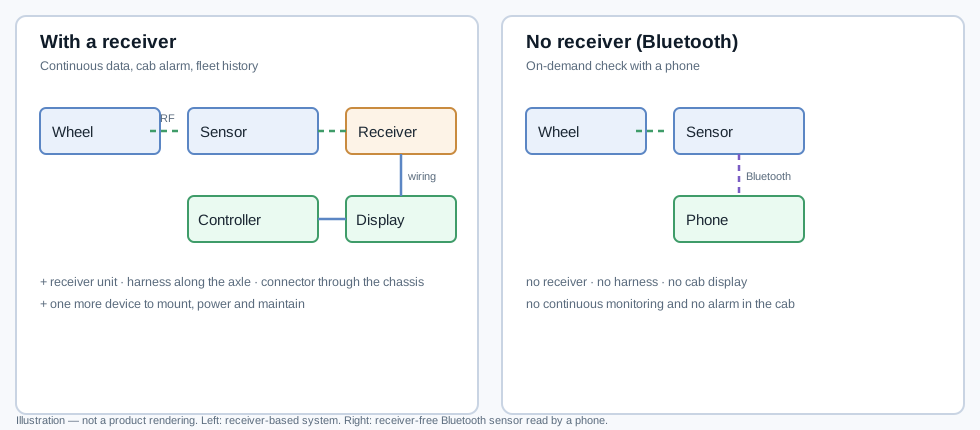
A TPMS with a receiver gives you one thing a phone cannot: the data arrives whether or not anybody is looking. The receiver sits on the vehicle, collects every sensor on a fixed cycle, and hands the values to a display, a controller or a gateway. That is what makes an alarm possible — because something is always listening.
A receiver-free sensor gives you a different thing: the ability to check when you decide to. No box to mount, no harness along the axle, no connector through the chassis. You take a phone, stand next to the wheel, and read the pressure.
What you save
- The receiver unit. One less device per vehicle to buy, mount, power and fail.
- The harness. No cable run along the axle, no additional connector through the chassis — which also means one less place for water and salt to get in.
- The display. No second screen in a cab that already has several.
- The installation visit. Fitting a receiver is a job; screwing on a sensor is not.
What you lose
- Continuous monitoring. Nothing is recorded while nobody is checking. A slow leak that develops overnight is only visible the next time somebody walks around with the phone.
- An alarm in the cab. There is no beep while driving, because there is no reader on the vehicle.
- Automatic history. You get a reading, not a trend line. If you need a log, it has to be exported from the phone.
- Fleet-wide view. One phone, one wheel at a time. Fine for a handful of vehicles; not a yard of forty.
TPMS without receiver: how far the phone actually reaches
TPMS without receiver: 2.4 GHz BLE 4.1, phone as the display, 0-500 kPa at ±2 kPa.
A receiver-free TPMS is a range question, not a feature question: 2.4 GHz BLE 4.1 reaches a phone that is close to the vehicle, which is right for a rider, a yard walk or a maintenance round, and wrong for a machine in a pit with the operator in a cab. Where the reading has to be continuous and delivered to a controller, a receiver belongs in the system; where it has to be checkable on demand, the phone is enough.
When the receiver-free version is the right answer
| Situation | Why it fits |
|---|---|
| Pre-ride or pre-trip checks | The vehicle is checked before it leaves, by the person who will ride it. Nothing needs to be watching in between. |
| Retrofit where wiring is not practical | Small vehicles, shared vehicles, or machines where running a harness is more work than the problem justifies. |
| You already have a Bluetooth gateway | The sensor talks to the hardware you installed for other reasons — no new infrastructure. |
If instead you need an alarm at the dash, an automatic log, or every wheel on every vehicle watched at once, that is a receiver system — and we make both. The honest answer is to pick the architecture that matches how the vehicle is actually used.
Specification of the receiver-free sensor
| Item | Value |
|---|---|
| Wireless | Bluetooth 5.1, 2.4 GHz — no receiver required, the phone is the reader |
| Pressure range | 0–500 kPa gauge (0–600 kPa absolute) |
| Accuracy | ±2 kPa |
| Battery | Replaceable CR1632, average service life about 1.5 years, no re-pairing after a change |
| Working / storage temperature | −20 to +80 °C / −40 to +85 °C |
| Sealing | IP67 |
| Size | Diameter 21 mm × 16 mm high |
Want samples or a specification for your programme?
Tell us the vehicle, wheel count, where the data should go, and the label language for your market. We answer in writing.
This page in: English · Español · Português · Français · Deutsch · Русский · 中文 · العربية
No receiver, just a phone
What this shows: a sensor reporting with no receiver in the chain - the phone is the reading device.